
Service
IoMT & Medical Device Isolation

A modern hospital or clinic runs on connected hardware that was never designed to share a network. Infusion pumps, imaging systems, telemetry monitors and bedside diagnostics all talk to servers, workstations and sometimes the internet — often on operating systems the manufacturer no longer updates. Trustbridge builds security boundaries around that hardware, so a single compromised device stays contained and the equipment your clinicians depend on keeps working.
Why Connected Medical Devices Are Different
Ordinary IT security assumes you can patch a machine, install protective software on it, and take it offline when something looks wrong. Medical devices break all three assumptions. Many are cleared as a fixed configuration, so they cannot be freely patched without affecting their approved state. Most will not accept endpoint software at all. And none of them can simply be unplugged while a patient is connected to them.
The result is a fleet of sensitive, long-lived, largely unpatchable equipment sitting on the same network as everything else. Isolation is the honest answer: when you cannot harden the device itself, you control precisely what it is allowed to reach.
What Device Isolation Involves
- Full device inventory Identify every connected device on the network, including the ones nobody has documented, and establish what each one actually is.
- Traffic baselining Observe how each device genuinely communicates during normal operation before a single policy is written.
- Purpose-built boundaries Permit the specific connections a device needs to do its clinical job, and nothing beyond that.
- Staged enforcement Model and simulate policies against live traffic, then enforce in phases so nothing is cut off mid-procedure.
- Ongoing coverage New devices arrive constantly, so the policy framework has to recognize and place them automatically.
Contained by Design
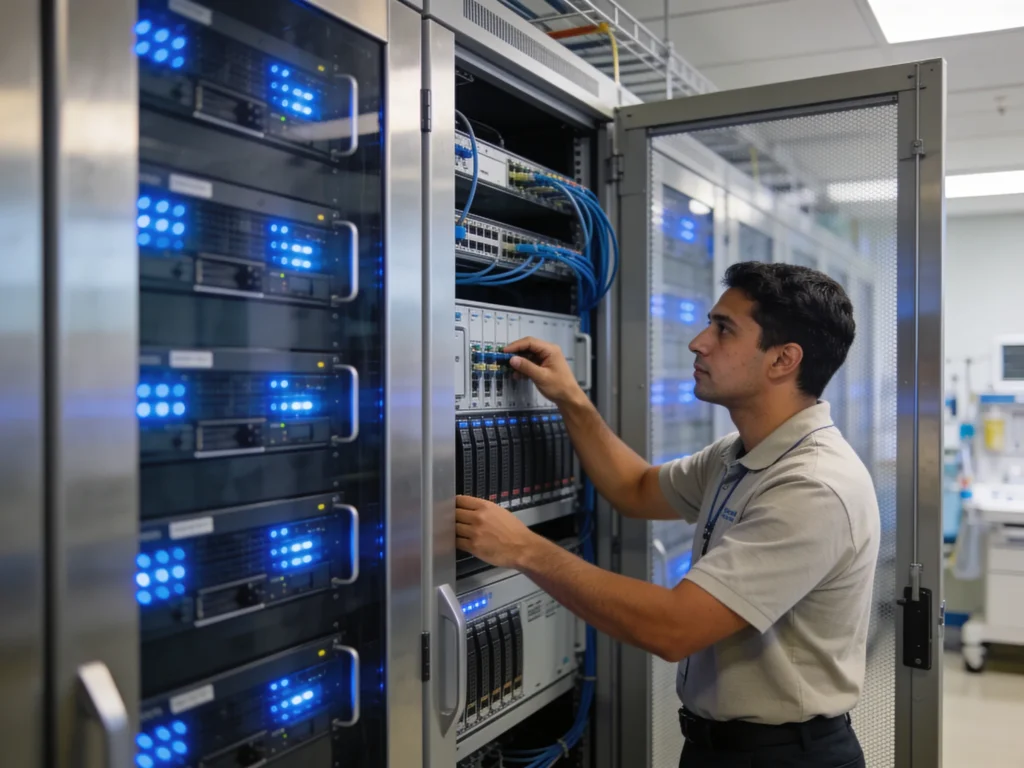
The purpose of isolation is not to stop every intrusion. It is to make an intrusion survivable. When a compromised workstation cannot reach the infusion pump network, and that network cannot reach the record system, an event that would have halted the organization becomes a contained problem on one segment.
That containment is what keeps care running during an incident — and it is what an investigator, an insurer or a regulator will ask you to demonstrate afterward.
Talk to Us About Your Device Environment
If you are not certain what is connected to your clinical network today, that is the normal starting point, not an embarrassment. Reach out for an introductory conversation and we will walk through what you have, where the exposure sits, and what isolation would realistically involve for an organization your size.
Explore our full range of services
All services-
EHR & Patient Data Protection
Enforce strict zero-trust communication policies between database servers, application layers, and clinical workstations to keep PHI isolated and fully secure.
-
HIPAA & Regulatory Alignment
Automate network segmentation policies to satisfy stringent compliance mandates, complete audit trails, and simplify third-party risk assessments.
-
Legacy System Encapsulation
Protect aging, unpatchable healthcare software and legacy operating systems without requiring costly infrastructure overhauls or system downtime.